
Searching Ohio County Criminal Dockets
Start any Ohio County criminal docket search at Indiana MyCase. That portal pulls public case information straight from Odyssey, the state's case-management system. Add the Ohio Circuit Court filter when the results get noisy. A case number is the strongest key. One number, one file. Without it, run a party search. Narrow the results by court, criminal case type, status, and filing-date range so the docket you want does not drown in matches.
Treat MyCase as a window, not the record itself. The state help page warns that entries can contain errors or omissions. Financial data may lag, older material may be missing, and searches cut off at 1,000 results. So keep the sequence tight.
- Enter the full case number from a notice or charging paper when available.
- Otherwise search by party, then choose Ohio Circuit Court and the likely criminal code.
- Compare the court code, case type, filing date, and open or closed status.
- Open the matching Chronological Case Summary and read events in date order.
- Contact the clerk for the official record, a missing public document, or a copy.
Ohio County Criminal Case Codes
A current Ohio County criminal docket entry starts with the Ohio Circuit Court identifier 58C01. From there, Indiana builds the case number in pieces. The filing year and month come next, then a case-type code, then a six-digit sequence. Take the sample 58C01-2608-CM-000123. The pieces describe a misdemeanor filed in August 2026, though the number points to no real case.
- CM
- Criminal misdemeanor.
- F1 through F6
- Current felony levels.
- MR
- Murder.
- MC
- Miscellaneous criminal.
- PC
- Post-conviction relief.
Dig far enough back in Ohio County court records and the numbering changes. Older files carry codes like FA through FD or CF. Those mark legacy classifications rather than a separate court. For help decoding the number itself, Administrative Rule 8 spells out the format, while the CCS gives you the events and the current status of the case.
Inside an Ohio County Criminal Docket
Indiana trial courts keep their event history in the Chronological Case Summary. It is known as the CCS. Think of it as a sequential register. It is not a transcript, and it is not the full case file. Dates can trip up a first-time reader. The entry date records when the clerk logged the event, which is not always the day of the hearing. A docket line may also be brief on purpose. It can point to a full order without restating what that order says.
| Case header | Case number, Ohio Circuit Court, criminal type, filing date, and status. |
|---|---|
| Charge event | The filed charge and classification; the code does not prove the result. |
| Setting | Initial hearing, pretrial, plea, trial, sentencing, or another scheduled event. |
| Motion or order | A dated filing or ruling; a public linked document may have more detail. |
| Disposition | Dismissal, plea, verdict, sentence, closure, or another recorded resolution. |
Trial Rule 77 separates three things: the CCS, the case file, and the Record of Judgments and Orders. The split matters. One docket line rarely settles a question on its own, so knowing which record holds the answer saves you a trip down the wrong path.
Ohio County Criminal Hearing Pattern
Ohio County dockets follow a weekly rhythm set by shared local criminal rules. Initial hearings for bonded-out defendants, and for people served by summons, land on Monday and Thursday at 1:30 p.m. Incarcerated defendants get their initial hearings those same days at 2:00 p.m. Friday slots are set by the court. Treat this as a pattern, not a promise. The newest order in the case always controls.
Miss a hearing and the stakes climb fast. A failure to appear can revoke bail and trigger an arrest warrant. The rules also provide for review after misdemeanor detention, plus weekly bond review in certain Level 6 felony and misdemeanor matters. So read the latest CCS setting first. When timing really matters, confirm it with the clerk. A later continuance, reassignment, or order can change everything.
The Indiana courts' daily-docket explanation shows how calendar data may be made public.
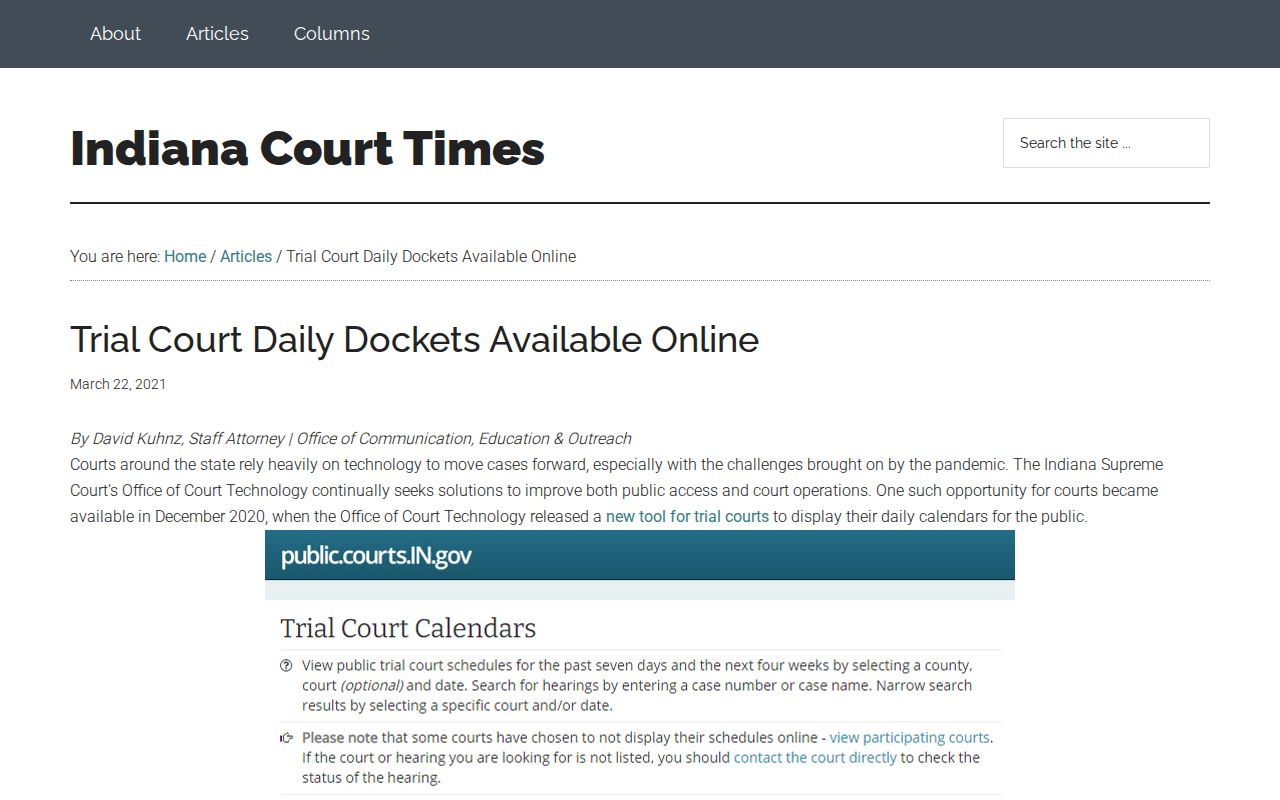
A posted schedule is only a snapshot. The current CCS entry, plus any order from the court, controls a setting that has changed since the calendar went up.
How a Criminal Case Moves
No criminal case moves through every stage the same way. The CCS tracks the route yours actually took. A summons can stand in for a warrant. A plea can end the charge before trial. A motion, bond review, continuance, or special-judge entry can insert extra steps. Read each event with its date, then look for the next order.
Docket flow: Charge Filed › Initial Hearing or Arraignment › Pretrial Settings › Plea or Trial › Disposition › Sentencing
Read each Ohio County criminal docket entry for what it actually says. "Filed" marks a request reaching the clerk; nobody has granted it. "Continued" moves a hearing or trial to a new date. That is all it means. "Disposed" shows the case reached a resolution. Yet payment, probation, restitution, or administrative work can still be open. A sentencing entry stays public when treatment or supervision material is kept out of it.
Ohio County Criminal Plea Timing
Ohio local rule LR58-CR-2 answers a puzzle many people hit in a late-stage Ohio County criminal docket. That rule covers a negotiated plea for a misdemeanor or a Class D or Level 6 felony tied to a jury trial. The plea must be written, signed, and tendered at least 14 days before trial. Once inside that window, a guilty plea generally comes without a recommendation, unless special circumstances the rule names apply.
So a tendered plea, a trial setting, and a later order can land close together in the docket. The timing makes sense once you know the rule. None of it predicts what the judge will accept. The current local rule, the filed plea, and the court order control the outcome. The Ohio County CCS may show a plea was tendered. Some terms can stay off the online record.
Courts That Hold Criminal Dockets
Ohio County runs its criminal docket through one court of record, Ohio Circuit Court 58C01. Every felony, misdemeanor, infraction, and ordinance case filed in the county goes there. That is the local rule. The former Ohio Superior Court 58D01 is listed as abolished. A legacy paper naming it may call for help from the clerk. A fresh docket search should not assume a second court exists.
The circuit judge and magistrate also serve Dearborn County. When a criminal conflict arises, the case can be assigned elsewhere. The assignment can go to Dearborn, Switzerland, or Ripley counties instead. That reassignment shows up in the original CCS. So search the original case number and follow the transfer or special-judge entry. Federal charges sit outside this system entirely. Those run through PACER or federal CM/ECF with the Southern District of Indiana.
Ohio County Criminal E-Filing Limits
Filing online and searching online are two different things in Indiana. The state's e-filing system moves documents into the court. Only attorneys and approved filers can use it through a provider. It was never built as a public docket search. For the public view of a case, MyCase is the tool. Just because a document was e-filed does not mean the public can see it. Access rules decide what shows up online.
The Indiana e-filing page names the approved providers and offers support details.
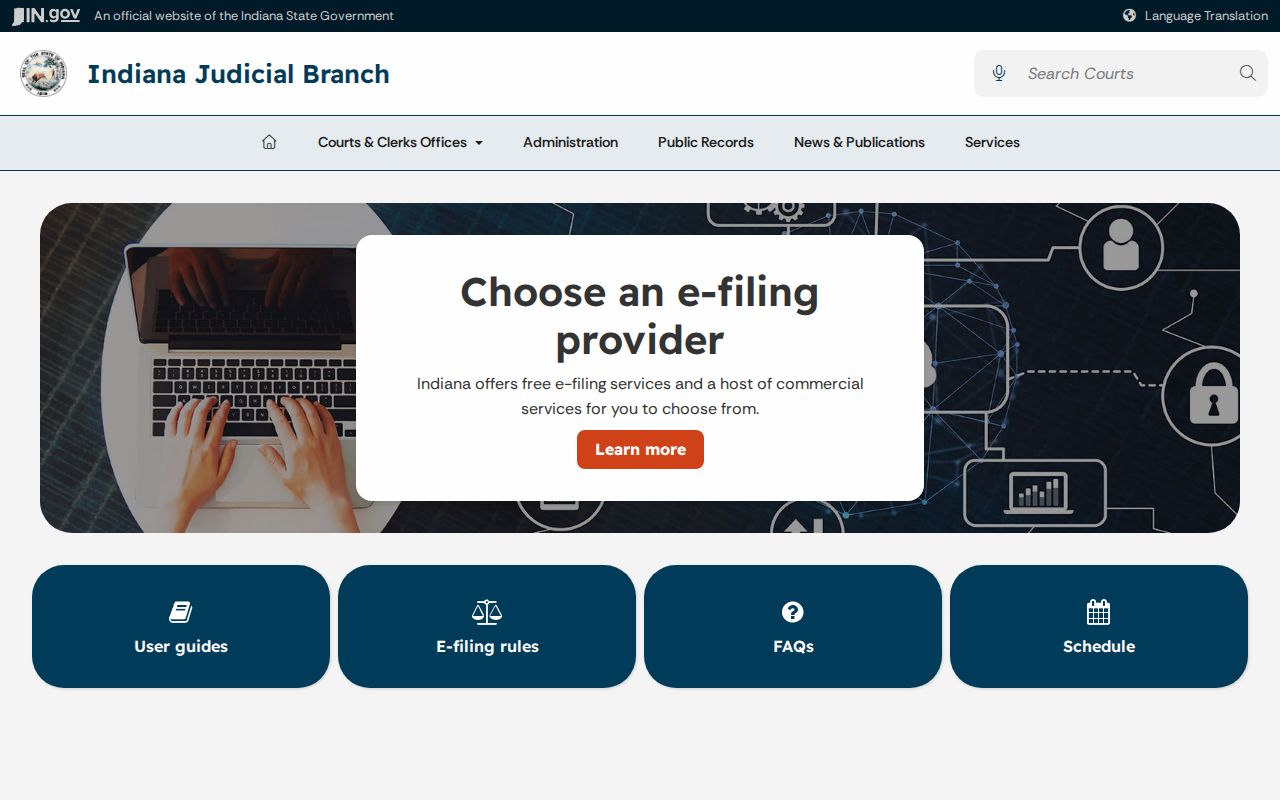
One trap catches people here. A filing receipt only proves the document was submitted; acceptance and any court action still have to be confirmed in the case record itself.
Ohio County Criminal Record Channels
MyCase is the easiest starting point. A docket search there returns the public case header and the CCS chronology. It also shows hearing settings and any document link the state provides. But the official record lives with the Ohio County Clerk of the Circuit Court. That office handles inspection, plain copies, certified copies, and help locating a public item. Visit Room 207 at 413 Main Street, Rising Sun, Indiana 47040. The clerk page lists 812-438-2610. Hours are 8:00 a.m. to noon and 1:00 p.m. to 4:00 p.m. weekdays.
Put the essentials in writing when you mail a request: Ohio Circuit Court, the case number, the exact item or entry date, the copy type, and how you want delivery. A quick phone call can confirm the right process first. Transcript orders go to the court reporter, who follows a local written-request and deposit rule. Indiana's request guidance walks through which office holds which records.
Sealed Dockets and Public Access
Indiana leans toward openness, but the exceptions have teeth. A fully visible Ohio County case can still contain a document withheld from the online public layer. Sealed cases, expunged records, pretrial-release and problem-solving-court supervision records, medical and treatment records, privileged items, and protected data may all be withheld or redacted.
Key access rules:
Court Records Rule 4 states the access presumption.
Rule 5 lists excluded cases, records, and data.
Administrative Rule 9 governs remote systems and calendars.
Indiana's Access to Public Records Act gives the broader agency principle but does not override court exclusions.
How much of the paper file goes online also depends on the case type. Under the state table, sentencing orders rank among the criminal materials commonly posted. Charging papers, evidence, and supervision records carry no such promise. A CCS line saying an affidavit or motion was filed proves the event happened in the chronology. It proves nothing about whether the filing itself can be downloaded or even disclosed.
A missing result proves nothing either. Dismissal, expungement, and a case that was never filed all look the same from the outside. Before assuming anything, check the spelling, the case number, the court, legacy status, and filing delay. Then ask the clerk about access status. Ask about an old paper file, a missing scan, or another office that holds the record.