
Searching Ohio County Civil Dockets
Start any Ohio County civil docket search at the state's free portal, Indiana MyCase. The best tool is a full case number. Type it in and the right file appears at once. If you lack a number, narrow the hunt instead. Pick a party or attorney name, choose Ohio Circuit Court, then trim the results by case type, open or closed status, or a filing-date range. For a company, its exact legal name works best. Or try the wildcard pattern explained in the state's search tips.
Know the portal's limits, though. MyCase is not the official court record for Ohio County. Old filings and public documents never posted online simply will not show up. Results also stop at 1,000 entries. A broad docket search can hit the cap, so keep your filters tight.
- Search the full Ohio County case number if it appears on a notice or filing.
- Otherwise enter a party or attorney name and choose Ohio Circuit Court.
- Add the likely civil type and a useful date range.
- Compare the caption, case code, filing date, and status before opening a result.
- Read the CCS, then ask the clerk for an official, plain, or certified copy when needed.
Ohio County Civil Case Codes
Civil matters in Ohio County run through Ohio Circuit Court 58C01. The case number itself carries a code that tells you more than a bare "civil" tag ever could. Take the made-up example 58C01-2608-CT-000123. That string stands for an Ohio Circuit Court tort case filed in August 2026, and it is only an illustration, not a live docket.
| Code | Ohio County civil case family |
|---|---|
| CC / CE | Civil collection or commercial eligible |
| CT / PL / MI | Civil tort, plenary, or miscellaneous civil |
| EV / MF | Eviction petition or mortgage foreclosure |
| SC | Small claims |
| DC / DN / DR | Domestic and family matters |
| TP / TS / RA | Tax deed, tax sale, or judicial review |
A case code sorts the file into a category and nothing more. It will not map every claim. It does not say who won. The full Indiana Rule 8 list goes further, adding protection, expungement, visitation, and support codes. Each of those carries its own access rules.
Inside an Ohio County Civil Docket
An Ohio County civil docket has layers. The Chronological Case Summary, called the CCS, lines up each judicial event by date. Pleadings and other papers live in the case file. Original orders, entries, and judgments sit in the Record of Judgments and Orders. Each layer serves a distinct purpose. A CCS entry is meant to be brief but meaningful. It is not the full text of an order. Dates can also shift: the day the clerk enters an event may differ from the day of the hearing or filing it describes.
| Case header | 58C01 number, case type, filing date, court, and status. |
|---|---|
| Parties | Public caption and appearances, subject to privacy and access rules. |
| Filings | Complaint, response, service, motion, brief, or other filed event. |
| Settings | Conference, hearing, mediation, trial, or another scheduled event. |
| Outcome | Order, judgment, settlement entry, dismissal, execution, or closure. |
Suppose the docket says summary judgment was granted. That entry gives you a result, not the court's reasoning. Look for a public order linked in the record, or ask the clerk for a copy. Trial Rule 77 spells out these record layers.
Ohio County Small Claims Route
Ohio County sends small claims through Ohio Circuit Court rather than a stand-alone small-claims court. Files carry the SC code. Expect CCS entries for service, hearing notice, judgment, payment, and collection steps as the case moves. When several defendants are involved, ask the clerk to confirm the filing and service route that applies now.
Fees deserve a careful look. The statewide fee manual's itemized example lands a small-claims filing near $97. A lower electronic-filing amount applies, with possible service charges on top. That figure comes from a statewide schedule. It is not a quote for any specific Ohio County filing. Before you file, confirm the current total, the service method, how many defendants you have, and what payment the clerk accepts.
Small claims still live on the civil docket. A judgment entry tells you what the court ordered, nothing more. Later collection or satisfaction events can show up afterward. So a docket marked closed is not the last word on every post-judgment act.
Civil Case Types on the Docket
One circuit court handles Ohio County's civil docket, and the mix is broad. Collections involve claimed debts. Tort cases involve alleged civil harm. Plenary and miscellaneous codes catch the claims that fit no narrower family, while mortgage foreclosure, eviction, tax, judicial-review, small-claims, and domestic files each carry their own procedural and access quirks.
- Collections and commercial eligible matters
- Tort, plenary, and miscellaneous civil cases
- Eviction and mortgage foreclosure files
- Small claims and post-judgment events
- Domestic, visitation, and reciprocal-support matters
- Tax deed, tax sale, and judicial-review cases
Protection-order and expungement cases deserve more care than a routine civil docket search. A family docket may show a public header or CCS entry while the online document set stays narrow. To identify the family correctly, rely on the case code rather than a guess drawn from a party name.
Ohio County Civil Filing Cutoff
Local rule LR58-TR-4 gives a concrete reason to check the CCS entry date on any Ohio County civil filing. Anything filed after 4:00 p.m. counts as filed the next business day. That is the default, unless the same-day procedure in the rule applies. So a submission timestamp and the official filing event can land on different dates. The docket entry is the checkpoint that shows what the court accepted and when.
The official Indiana e-filing system is a filing channel, not a civil docket search. An e-filing receipt proves you submitted something. It does not prove acceptance, the judge's action, or public access to the document. MyCase provides the public case layer. The clerk's official record settles any dispute over the filing date.
Civil Docket Settings and Hearings
Settings are the backbone of a civil CCS entry. You might see a case-management conference, a motion hearing, mediation, a trial date, or a judgment entry. The newest entry wins. A continuance moves a date but keeps the claim alive, and a scheduling order can lay out several deadlines that a later order revises in part or whole. When accuracy matters, confirm the dates and financial details in MyCase too.
Timing rules shape what you read. Under LR58-TR-9, Ohio County generally frowns on a continuance request made within two weeks of a trial or hearing unless both counsel appear in person to explain it, save for an extreme emergency. Requests still get granted sometimes. That is why a request, an appearance, a ruling, and a reset often sit close together on the Ohio County civil docket.
Family cases run on their own clock. LR58-FL-4 covers provisional orders and a proposed hearing date, and the scheduler tries to set the matter within the stated local period. Still, the date in the latest case order controls over any rule's target.
Ohio County Civil Motion Timing
Motions move fast here. Local rule LR58-TR-3 says a motion should reach the judge within five days. Dispositive motions need a supporting brief or memorandum plus proof of service. Those include motions to dismiss, for judgment on the pleadings, and for summary judgment. The other side then has 15 days after service under that rule.
Expect several distinct entries from one dispute. A motion gets filed, served, briefed, taken under advisement, and ruled on. Reading the entry titles carefully matters. "Motion filed" is a request, not a grant. "Summary judgment granted" names the ruling, but it may not say which claims it resolved or why. Read the linked order when it is public, or ask the clerk for access. Never guess the outcome from a motion's title alone.
Ohio County Civil Record Channels
Two channels cover most needs. MyCase gives you the public case header, the CCS, upcoming settings, and links to any documents available online. The official search tips walk through filters for party, attorney, wildcard, court, status, and date. For the official file itself, an in-person inspection, a plain copy, a certified judgment, or a document with no online link, go to the Ohio County Clerk of the Circuit Court. That office sits in Room 207 at 413 Main Street, Rising Sun, Indiana 47040. The clerk page lists 812-438-2610.
A written or mailed request works best when it is specific. Name Ohio Circuit Court, give the case number, identify the exact record or entry date, say whether you want inspection or a plain or certified copy, and include delivery details. A quick phone call can confirm the fees. Transcripts are different. They go through the court reporter under the local request and deposit rule. One caution: the recorder, treasurer, assessor, or another county office may hold a related land or tax record. None of them holds the court's CCS.
Civil Docket Access Rules
Public does not mean everything shows. Even in an open civil case, medical and treatment information, financial identifiers, evaluation reports, privileged material, sealed exhibits, protected addresses, and documents covered by a court order may be withheld or redacted. Family, protection-order, paternity, mental-health, and expungement records carry special limits of their own. And a public judgment never makes every exhibit public.
Indiana access framework:
Court Records Rule 4 starts with general accessibility.
Rule 5 defines excluded cases, records, and protected data.
Administrative Rule 9 governs remote access and electronic systems.
Indiana's Access to Public Records Act states a wider public-record principle but does not override a seal or court-record rule.
The current 2025 provisional statistics notice is shown on the Indiana trial-court statistics page.
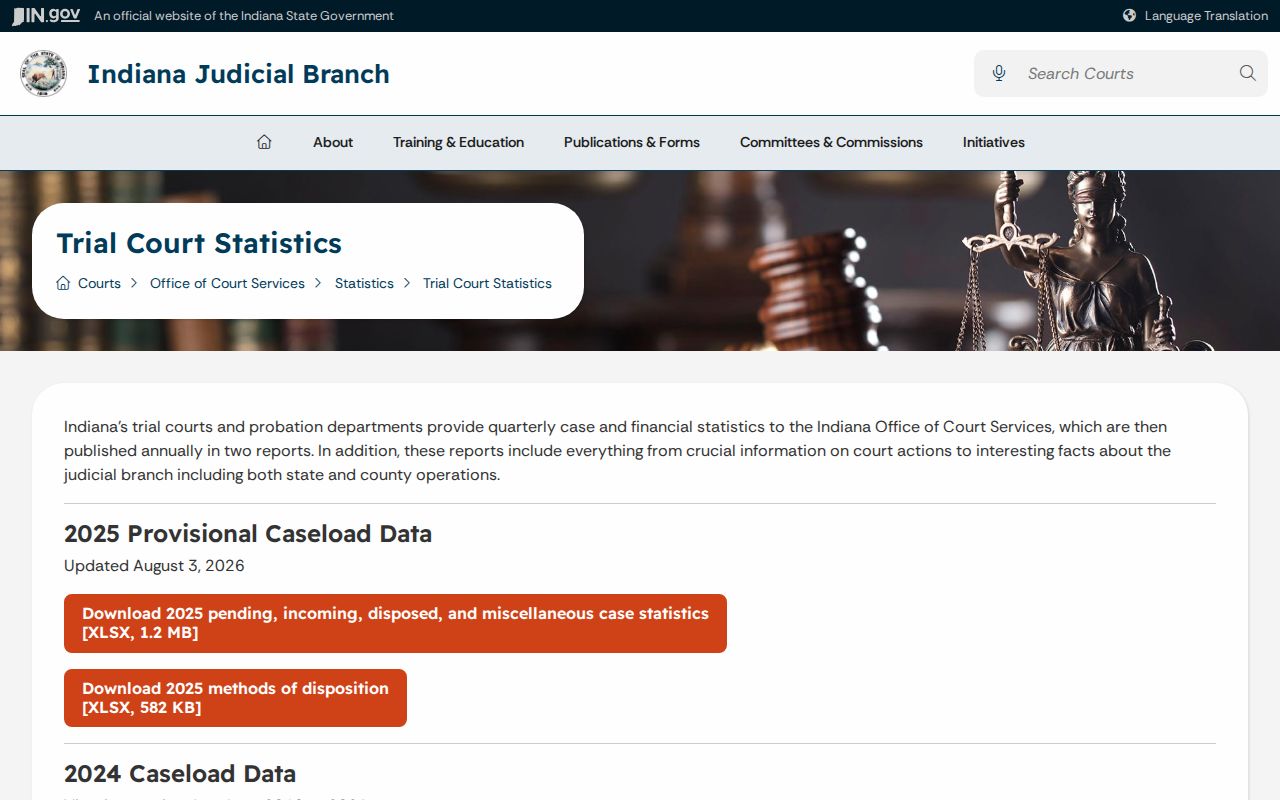
The notice is a simple caution. Statewide reporting can be provisional, so verify a specific Ohio County civil case against its official clerk record.